Demonstrate. “Once you’ve taught curly clients ways to style their hair,” Parvin notes, “they can be cheerleaders and send you more clients.” Anthony Cress estimates that he gets five new curly clients for each texture client he enlightens. “Texture clients have had curly hair their whole lives, and yet no stylist has told them tips on how to work with it,” Cress says. “I walk them through it step-by-step .” On the Ouidad Salon in Santa Monica, California,Ouidad educator Morgan Willhite posts how-to videos for curly clients to access. And while they’re in her chair, the clients style a section of their new look under her supervision. “It’s true of all clients, but with textured clients you want to make extra-sure they can maintain the look themselves,” Willhite notes. “If you teach the textured client about her hair and her new style, she’ll trust you.” Clients transitioning from relaxing services to natural hair need re-education. “Most clients who were relaxing their hair are still fighting the curl,” says Cress. “That’s because
they don’t know the best way to work with curly hair. Once they do, their whole life changes.”
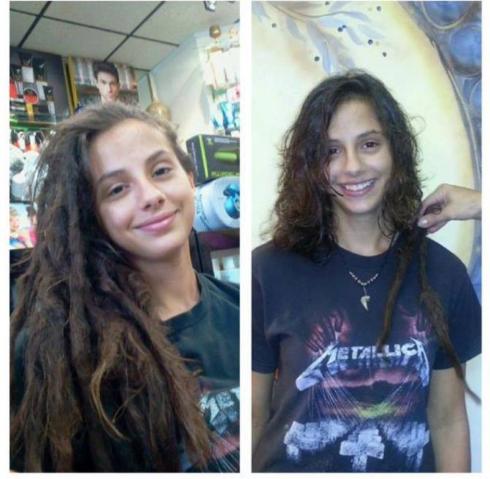
Educate yourself. “First and foremost, really learn and make sure you know how to work with confidence on all types of textured hair,” Ruiz advises. “Specializing means you’re an expert at something,” adds Franco Della Grazia, global artist and texture ambassador for Matrix and a leading stylist at Cutler Salon in NYC. “When a client asks you a question about texture, you need to be able to answer it. You can’t fool someone with textured hair. Hairdressers who are successful at this are the ones who really know their craft.” click image to zoom  Texture classes and videos are becoming more common. Christo offers both at his salon, while Hill’s stylists research the product formulas and present the information to each other. Willhite suggests becoming certified in texture. “In 2000, I became the third person to be certified by Ouidad,” she says. “Today more than 250 salons are Ouidad-certified, applying to multiple stylists per salon. Our facility in New York offers training in how to properly cut curly hair and how to use all of the styling products. It’s hands-on technical training, but you’re also training your eye to look at hair differently because of the texture.” To truly be a texture specialist, Della Grazia maintains that you need to be able not just to manage curl but to create it. “We aren’t calling them ‘perms’ anymore, because we’re changing the perception,” he says. “We’re just getting bend on the ends and lift at the root, so we’re putting in fewer rods. There’s a huge market for this; not everyone is born with the beachy hair texture that women desire today.”
Facebook! Also tweet! Post videos on YouTube! If any industry benefits from social media, it’s the visually inspired beauty industry. Posting your work online communicates that you’re serious about what you’re doing, says Jessee, who owns Sherri’s Hair Salon in Bristol, Virginia. “When you post a lot,” she notes, “eventually people will want to find out more about you and your salon.” Christo estimates that his p.r. team spends two to three hours a day on social media in addition to one staffer who is a dedicated social media marketer. “We do it all,” Christo says. “Facebook, Instagram, Tumbler, Pinterest—you name it. We do a lot of fun stuff, and our contact list keeps growing and growing. One morning, I sent out a stylist and make-up artist to do a financial advisor who was going to be on TV and has more than 25,000 followers on Twitter. We exchanged our services for her tweets plus one Instagram. You would be amazed at how many people you can reach.” Hill reminds stylists not to neglect the hashtag. “We constantly get new people joining our Instagram page just from seeing a photo that pops up on a hashtag like ‘hair,’ ‘curly hair,’ ‘natural hair’ or ‘textured hair,’” she says.
Google. To assess your online marketing power, don’t google the name of your salon; google what potential clients are googling. “I ask new clients how they found us, and often their answer is that they did a search on ‘best curly stylist’ in their geographic area,” says Willhite. Do that same search; if your name doesn’t show up on the first page, work harder to create an association between your salon and curly hair. Make sure your website includes keywords like “curly,” “frizzy” and “texture” as well as the name of your curl-friendly product line. Write a blog, which creates fresh content regularly—something the Google engine notices. And don’t forget to send out press releases. “Two months ago The Wall Street Journal came into our salon under cover and gave us the best review!” Christo recalls. “We got a lot of clients from that. It’s always effective when a respected publication tells your story.”
Heal. The typical texture client who comes to you has hair that’s dry, stressed and damaged. Fix it! “For the hair to show off its natural curl, it has to be in good condition,” says Cress. “Being a texture expert starts with priming the hair with shampoo and conditioner,” agrees Parvin. “Understanding the fabric will set you apart and also get better styling results. Companies are emphasizing styling products that also hydrate, so you’re providing the moisture first and then the hold.” Invite. At Planet Curls Salon in Houston, Texas, Geri Curtis holds “curl parties” to bring in curly clients and their friends. Make it fun while showing your guests tips to style their curly locks and solve their
hair challenges.
Jump-start your speciality. “The first thing I did when I decided to go full-force into texture was to advertise on NaturallyCurly.com,” says Hill. Curlies search that website for texture-savvy local salons, and Hill says her ad attracted a core clientele. Hill also includes her texture specialty as well as her texture-targeted product brand on her business cards. “I hand out my card everywhere,” Hill says. “When I see someone with curly hair, I give her my card and say, ‘Hey you should check out our website.’”
Keyword: Keratin. With texture clients looking to eliminate frizz, keratin services and other smoothing systems can be an appropriate solution. Clients rely on you to keep your eye on that moving target because the smoothing story continues to change. From explaining the chemistry to delivering a flawless result, you should know your smoothing systems.
Look! Closely analyze the client’s hair, because what you see is not necessarily what you’re getting. “If a new client comes in with her hair blown dry but wants to commit to wearing a curly style, I sometimes wet and condition the hair and put the client under a dryer,” says Willhite. “You have to find out how the cut will fall and how the hair will dry.” Cress, too, makes sure he analyzes the hair right after it’s shampooed. “Any hidden little trick she’d done to style her curly hair gets washed away,” he says. “You see the truth in curly hair when it’s wet. You see how strong that curl pattern is; the idea is for the dry look to mimic the way the hair naturally looks when it’s wet.” Della Grazia agrees that curly hair has a mind of its own. “It always falls back into the same curl,” he notes, “so when you try to push it into a shape it doesn’t want to go, it won’t do it.” Touching is as important as looking, Cress adds. “As hairstylists, we ‘see’ with our hands,” he says. Della Grazia recommends observing the client holistically, taking in her demeanor and body language. “You can tell whether the client loves the spirit of curly hair or is frustrated about it,” he explains.
Merchandise. One quick way to communicate your texture specialty is to create attractive displays of curl-targeted products. “Having those products on your shelves helps to reinforce your position as a texture expert,” says Ruiz. “Separate your textured-hair products from your other products,” suggests Christo, whose salon carries his own curly-formula click image to zoom 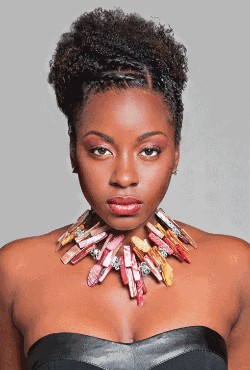 products. “In addition, have the products right there with you during the consultation. The client has to get the connection that you have this speciality.” At Cutler Salon, Della Grazia says all of the curly products “sit in their own little family,” and the stylist’s workspace remains bare of products until the stylist begins using them. “We go get the product we’re using and bring it back to our station so the client can focus on it,” Della Grazia says. “It dilutes the retail experience to have a lot of products at your station that you won’t be using.”
Name it! Curtis named her salon “Planet Curls” so there would be no mistake about her specialty. “Curly girls will find you no matter what your name is,” Curtis says, “but an obvious name will help them find you easier on the internet.” Hill’s business name came to her
in her sleep. “At 1 a.m. four years ago, I woke up and wrote down the name ‘DyeVerCity,’” Hill remembers. “People see that it’s a play on ‘Diversity.’ It’s worked out really well, because our salon caters to all types and cultures.”
Obsess. Notice texture on the street and in magazines, join curly hair forums online and practice constantly on mannequins or willing friends. “I am fortunate that our salon is multicultural, allowing me to work with textured hair on a daily basis,” says Ruiz. “Clients get bored, so you have to come up with new ideas,” adds Hill. “We set ourselves apart by not doing the same things clients see everywhere.” When you live and breathe texture, your familiarity with curl and affection for textured hair become apparent. “When a curly client walks in, through your body language and demeanor she will know immediately whether you’re comfortable with curly hair,” observes Willhite. “It puts clients at ease when you’re saying
all the right things during the consultation,” agrees Cress.
Partner. “Align yourself with a product line that has high-performance products that cater to textured hair,” advises Ruiz. Curtis says she partners with brands that “really care about the integrity of the hair. And I love companies that offer education.” Curlies have tried so many products that they’re less forgiving, observes Della Grazia. “They’ll use something once,” he notes, “and if they don’t get what they want out of it—bang, it’s gone.” Christo agrees. “Curly-haired clients are more demanding than clients with straight hair,” he says. “They come in with a lot of questions, and the stylist must know the answers. At least two or three stylists in the salon should learn everything about the line and be able to teach clients how to use the products to control frizz and style their hair.” Product knowledge strengthens your relationship with the client, says Hill. “At their next appointment, clients will say, ‘You were right—using the leave-in conditioner when I go swimming does keep my hair from drying out.’ The client learns to trust you.”
Question. And listen! The consultation is your time to shine. But before you give information, get some from the client. Hill says, “When texture clients complain about their hair, we ask them, ‘Why do you hate your curls?’ Most of them either aren’t using the right products, or else their hair used to be relaxed and now that their hair is natural they have to relearn how to manage it.” It’s also important to inquire about the client’s routine. “I ask clients how long they are willing to spend on their hair,” says Willhite. “I’m not going to show them a 30-minute styling process if they prefer to spend only 15 minutes. If I can’t give them exactly what they want, I find out what they really love about their hair and incorporate that into a look they’ll like.”
Reward, refer, rebook. Implementing reward, referral and rebooking systems will deliver two more R’s: recruiting and retention. Your business strategies that work for building any clientele are even more crucial to attracting and keeping curly clients, who have a complicated history with salons. Reward them with one complimentary service for every 10 paid services and again if they send you new clients. Toward the end of every visit, remember to say, “To maintain your style, I’ll need to see you in six weeks.” These systems work. Use them consistently, and you will watch your numbers climb.
Sample. Clients with thick, dense, textured hair can go through bottles of product in no time. And because they’re more open to trying new products than straight-haired clients are, many end up with drawers full of barely used products. Give them a break and hand out shampoo, conditioner and styling gel minis. “Getting free product is always appreciated!” confirms Cress, adding that even with a free sample it’s important to provide full instructions in the proper use so that the product works and they’ll come back to purchase the full size.
Tote the tools. Keeping your station stocked with big clips, wide-tooth combs and diffusers shows curlies that you understand their texture. “On textured hair, you don’t want to use a brush or comb with a lot of teeth or anything that breaks up and expands the curl,” Willhite cautions. Retailing the tools you use helps the client to recreate the look at home. “Clients may tell you that they use a sock over their hair dryer and then complain that they still have frizz,” says Willhite, “but a sock is probably not going to diminish their frizz! And if a client with straighter hair is trying to tease out curl, a sock will not give her the curl she wants. Both clients need to use a diffuser. Give the textured client a diffuser with teeth to help the curl formation and with walls around the edges to keep air from blowing out the sides and causing frizz.”
Up service. Don’t be afraid to add to the ticket with deep-conditioning, maybe a keratin service and, of course, retail. “Texture clients will pay whatever it takes to have healthy, beautiful hair,” Duckwall observes.
Volunteer. Heighten your visibility by getting out into the community and showing off your texture skills. “We do a lot of Fashion Week styling, and we make ourselves available to charities,” says Christo. “If I’m invited to a radio station to give advice, I go! Donating your time brings you clients, especially when you have a specialized business.” Hill seeks out events compatible with teaching women about their hair. “I was the featured speaker at an event for Natural Hair Awareness Month,” she reports. “This type of exposure positions you as an authority.”
Wear it. Be a curly if you can. “Many clients believe that only someone who has curly hair can understand curly hair,” says Curtis. “Some of my clients seem disappointed when they come in and see that I only have beach waves.” Although she straightens occasionally, Hill showcases her natural texture most of the time. click image to zoom 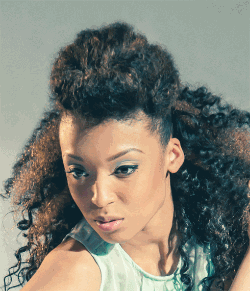 “A lot of my clients say they trust people who have hair that looks like theirs,” she notes. “They know the stylist will understand shrinkage and frizz.” Parvin relates. “When you’ve had curly hair all your life, the client knows that you’ve had to go through some rough times,” she laughs. “But that’s just perception. When stylists know and love hair, it doesn’t matter whether their own hair is curly or straight. A lot of very good stylists are men who are bald!”
Xtras. Just as you would with any client, go above and beyond expectations. The typical curly client has a long memory and plenty of bad salon stories, so ensure that she enjoys her time with you. Double up on your customer service protocol so that she feels welcome in the salon. “An extra-fantastic shampoo calms the nerves!” says Cress. Also greet her warmly, offer her a drink and let her know that you value her business.
Yelp! Of all the social media sites, Yelp may be the most pivotal to your business. Curlies like to help each other find solutions. “We’re always checking Yelp to see how we’re rated,” notes Della Grazia. “All you need is a couple of bad reviews, and your reputation is tarnished.” In fact, a 2012 study by two Berkeley economists of restaurants’ Yelp reviews found that just a half-star improvement on Yelp’s five-star rating made it as much as 49 percent more likely that a restaurant would fill up for dinner. “Clients might look up ‘best salon Ouidad products,’ and Yelp reviews will pop up immediately,” reports Willhite.
Zero in. “About 70 percent of women have wavy to coily hair, so it’s a big market,” says Christo. “There’s a movement right now to go natural; if you’re not servicing men and women with curly hair, you’re missing out. People are tired of fighting their curl, and you can have clients for a lifetime. So it’s best to teach them learn how to love their hair.” Parvin agrees. “Texture now is like hair color or highlighting,” she says. “You should be good at it, because lots of folk have it and
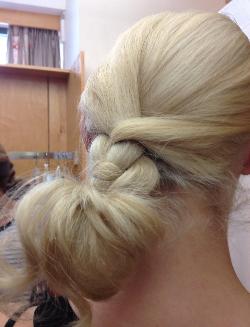 The “Bungee” braid on blonde hair. The hot JSONG Spring/Summer 2014 collection which premiered on at Manhattan Fashion Week recently, showcased many pretty pieces in white and lilac, ice blue and carnation pink pastels. The simple going styles were embellished with lace embroidery, pleats and lightweight linen textures.
 A look from the runway. STEP 1: Wave the hair with a wand half way down the shaft using 2-inch sections. No use for an excessive amount of curl. Use pure NV BKT Humidity Defense Styling Spray (aerosol) to set the feel as you wand.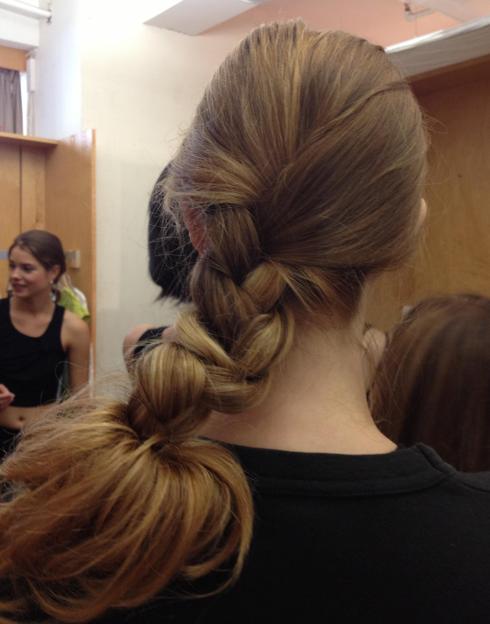


 0
0